
Since pulse oximeter help in checking the blood flow, heart rate, and oxygen saturation levels at home, it is very important to select a device that shows correct details. Before buying a pulse oximeter, make sure that you go through all the factors mentioned below:
Table of Contents
1. Accuracy:

Accuracy is one of the first things that you should check for before buying the pulse oximeter. Most of the devices deliver results within ±2% of the actual blood oxygen saturation level. This level of precision is helpful in analyzing the trend. You can also check whether your SpO2 levels are within a normal range or not.
Apart from this, it is also recommended to buy a pulse oximeter from a reputed and well-known brand as these devices offer more accurate details. You can even take your doctor’s recommendation to know which brand provides the best result.
2. Finger Size:

The pulse oximeter that you buy must fit in your fingers properly otherwise it will generate incorrect readings. In some cases, the oximeter might not show any reading at all. But, how do you decide which one will fit your finger perfectly?
Most of the latest models come with an adjustable spring system that lets you adjust the pulse oximeter according to the finger size. These models can accommodate a wide range of finger sizes and can be used by both children and adults.
If you are planning to share the pulse oximeter within your family, you must buy an adjustable model.
However, if you are buying the pulse oximeter for your children, you should select the model that is made especially for the pediatric purpose. The sensors in such pediatric devices are calibrated correctly to get the job done in the right way.
3. Display Size and Readability:
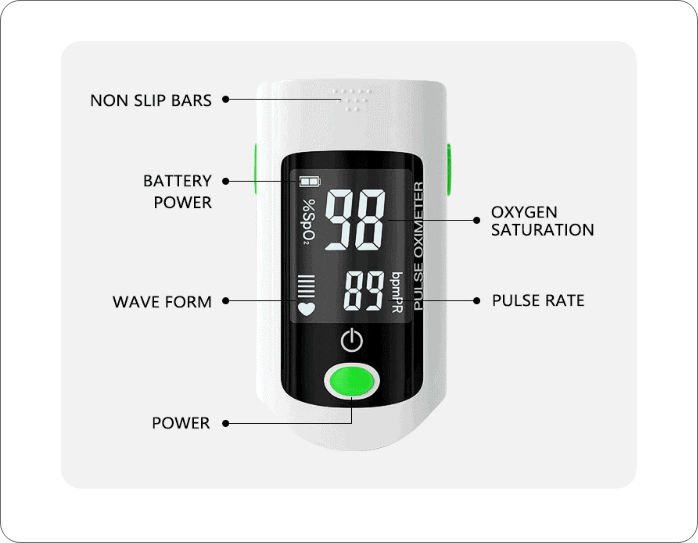
Since it is a small device, you should pay attention to see the numbers on the display. The pulse oximeter’s display size determines how easily you can see the readings.
It is always good to have large numbers on the display and different ways of arranging the data. You can choose the arrangement that you are comfortable with.
4. Bright Visible Display:
Check for a pulse oximeter that comes with a backlit display. There are many models available with different backlit and color combinations. You can select a combination that you like the most. It is totally your personal choice.
Some models even allow you to adjust the brightness levels so that it is comfortable to check the readings under any lighting conditions. We would suggest you to check for a pulse oximeter where the display offers multiple viewing angles. This will prevent your eyes from further straining.
5. Warning Systems:
There are 3 warning systems that you should check for:
- Irregular Heartbeat: If your heartbeat is not steady and constant, the pulse oximeter generates a sound warning or alarm. It also includes any arrhythmia of the heart too.
- Low SpO2: Even though you can see the reading on the display, a warning in the form of a beep or buzzer is helpful if the SpO2 levels drop down. You can even face dizziness or blurred vision if there is an inadequate supply of O2 concentration.
- Low Battery: For the patients or users who rely on the oximeter for their health management, a low battery indicator is necessary. With the help of this indicator, you can charge or replace the battery so that the device is working fine.
Pulse Oximeter Readings Chart

Heart Rate Readings Chart

6. Response Time:
Earlier, the pulse oximeters used to take around 30 seconds to show the reading. The modern devices take around 10 seconds to display accurate results.
7. Durability:
Durability is another important factor that you should consider before buying a pulse oximeter. A durable device prevents the damage of the unit and does not show inaccurate readings.
A good quality oximeter can provide the correct result every time you use it. Thus, buying an oximeter that is not durable can indirectly put your life at risk.
A durable unit is generally waterproof and can even withstand any condition. Even if you drop it on the ground, it will work fine. They are also resistant to humidity. Most of the times, incorrect reading or device failure is caused due to the humidity.
Some pulse oximeters even come along with removable silicon covers that guard the device against scratches or damage caused while using it. Some pulse oximeter units have shells that made using ABS (Acrylonitrile Butadiene Styrene) plastic that is more durable than the models that are made using polypropylene plastic shells.
8. Battery Life:
If you need to use the pulse oximeter daily, you must buy a device that can provide you continuous support. This is where the battery life comes into the picture.
To keep the oximeter working always, you can either buy a model that is powered using lithium batteries (that are rechargeable mostly) even though it is costly, or else you can buy a cheaper model that supports AAA batteries where it provides a minimum of 30 working hours.
9. Automatically Activated:
Automatically activated pulse oximeters are the ones that turn on automatically when you place your finger or toe in it. Even though it is not a very important feature, it can be helpful in some tricky situations where you need to check your pulse rate or SpO2 levels.
10. Ease of Usage:
A pulse oximeter should always be easy to use and must not require any technical knowledge so that anyone at home can use it without any assistance.
The finger oximeters are generally easy to use. All you have to do is clip the device on your finger and turn on the button and wait for a few seconds for the result. A large display or screen makes it easier to check the readings.
Some models of oximeters display the readings in different ways making it easier to read and understand the details. These added benefits can make it easy to use an oximeter.
11. Portability:
The patients who need to monitor their SpO2 levels usually carry the oximeter with them always. Even some pilots or sportsmen use an oximeter. In such cases, the oximeter should be portable so that you can put it in your pocket or handbag. All the oximeters that we have mentioned in the list are portable and easy to carry.
The size of most of the pulse oximeter is around 2 inches long and 1 inch wide. This size is good enough to fit in the pocket. However, if you are carrying it in your pocket, chances are device may turn on accidentally. Thus look for a model that comes with either a lanyard so that you can hang it around your neck or the model that comes with a carrying