“Reasons Why Refrigerator Is Not Cooling Enough”
Is your refrigerator not cooling? There can be several reasons for this to happen.
In this article, we have explored some of the common reasons that can cause in-sufficient cooling in a refrigerator.
We have also provided solutions to some issues that can be fixed at home. However, to resolve some issues, it is better to take help from a technician.
The very initial step to fixing the refrigerator is diagnosing the cause. Let us discuss the problems, both minor and major, in detail.
Table of Contents
Minor Causes Refrigerator Not Cooling:
As discussed earlier, there are many reasons for your refrigerator not cooling. However, it is advisable to check for the minor triggers first, before moving on to the complex ones directly.
1. Check Power Supply

One of the possible minor causes would be an inadequate power supply or no power supply at all. To confirm the same, open your refrigerator door and check for the light inside.
If the find the light turned on, then there is an adequate power supply. If you notice the light turned off, immediately check whether the power cord of the fridge is intact with the power outlet. While doing so, examine if the cord is healthy or not.
If you notice that there is no problem with the power cord and find it plugged in, check the power supply unit. Unplug the power cord and plug in some other electrical device.
If you identify that the problem is with the power outlet, immediately call for a professional electrician. However, if you are still unable to recognize the problem, then it is a clear indication that the fridge has indeed a complex issue.
2. Temperature Control Settings

Another trivial reason affecting the cooling of the refrigerator is the temperature. It can look very insignificant for us to realize, yet it could be a possible cause.
Hence, check the temperature control settings in your refrigerator. There are chances that it got accidentally shifted. If yes, reset the settings to the ideal temperature required to keep the food items cold, fresh, and healthy.
3. Blocked Air Vents

One of the contributing factors for this issues can be food load. It is always crucial to see that you are not overloading your fridge, especially near the air vent.
When you overstock your fridge or freezer with items, they block the air vent. This further prevents the cold air from entering the food compartment.
The location of these vents varies from brand to brand and model. Most refrigerators have them along the back wall inside or along the sidewall. You can always check the user owner manual for locating them.
Another possible reason can be – When your freezer is frosting over, it builds up ice in the freezer, which sometimes causes a vent blockage. This results in further blocking the airflow from reaching the refrigerator compartment.
When you notice heavy frost in the freezer compartment, defrost the chamber by unplugging the fridge. Keep the freezer door open and let the frost melt.
4. Examine Gasket

Examine the gasket of your refrigerator to see if it is in a good condition. If the seals of your fridge and freezer compartment are not as tight as they should be, it causes leakage of cool air. Make sure that the gaskets are tight, not broken or worn out.
You can test the condition of the seal by trying this simple hack. Put any paper or any bill in the door and see if it sticks to the door or falls out when you close the door. If it falls out or if you can easily pull it off the door, it means that the seal is bad, and you need to fix it.
In the above paragraphs, we discussed some basic troubleshooting techniques for a refrigerator when the fridge is not cooling. Let us now move on to the next vital segment that talks about more advanced inspections. We will try to learn the solutions as well.
Complex Causes for Refrigerator Not Cooling (with Solutions)
If none of the adjustments mentioned above are the causes, it means that the problem is quite complex. There could be faulty parts in your refrigerator-that are obstructing its cooling, and they are:
1. Frosted Evaporator Coil

The freezer compartment of the refrigerator has evaporator coils and circulating fans. Whenever the evaporator coil encounters a reduced airflow across, it leads to evaporator coil icing. This causes a frozen evaporator coil, preventing the air pass through them to get cold.
Solution
The only solution is to remove the frost from it either by manual defrosting or automatic defrost (a feature available in frost-free refrigerators). This ensures the required amount of airflow and proper cooling inside the fridge.
2. Faulty Evaporator Fan
You will find the refrigerator evaporator fan behind the freezer wall. The fab’s job is to draw air across the evaporator coil and circulate this cool air throughout the freezer and fridge compartments. Whenever it stops working, the fan fails to circulate the cool air. This may stop cooling your fridge section while keeping the freezer cold.
Solution
The ideal solution to this is to check for the proper working of the fan. Ensure there are no obstructions. If you notice that the fan is not running properly, or the noise is getting louder, or there are damaged motor windings, then it is time to replace them.
3. Thermistor

The thermistor is the crucial part of the refrigerator that controls the temperature inside. It is a sensor that monitors the temperature and sends the reading to the control board. Based on the thermistor readings, the control board regulates power to the evaporator fan and the compressor.
Any damage to the thermistor will hamper the functionality, i.e., both compressor and evaporator fan does not run as required and when necessary.
Solution
To combat this issue, it is essential to determine if the thermistor is defective using a multimeter. If you observe any change in the thermistor resistance during the test, you better replace it.
4. Refrigerant Level is Low

A refrigerant is a fluid responsible for cooling, i.e., the refrigeration cycle in the refrigerator. It works by absorbing (passes through evaporator coil) the heat from the food items inside and converts to high-pressure gas. (passes through the compressor). Eventually, it removes the heat from the condenser coil.
When this refrigerant fluid is low, it affects the refrigeration cycle and interrupts the refrigeration cycle. Ultimately, your refrigerator stops getting cool.
Solution
The one and the only solution is to measure the level of this coolant regularly.
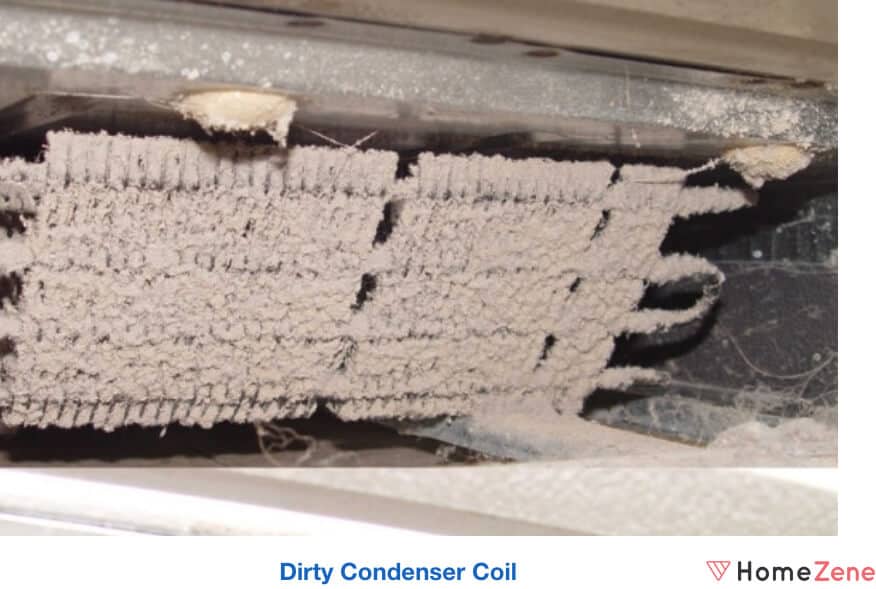
5. Dirty Condenser Coil